Overview
Researchers

Fiona Burlig
Assistant Professor, Harris School of Public Policy at the University of Chicago

Amir Jina
Assistant Professor, Harris School of Public Policy at the University of Chicago

Erin Kelley
Economist in the Development Impact Evaluation (DIME) unit at the World Bank

Gregory Lane
Assistant Professor of Economics, American University

Harshil Sahai
Ph.D. Candidate, University of Chicago
- Country
- India
- Constraints
- Information
- Technology Category
- Extension
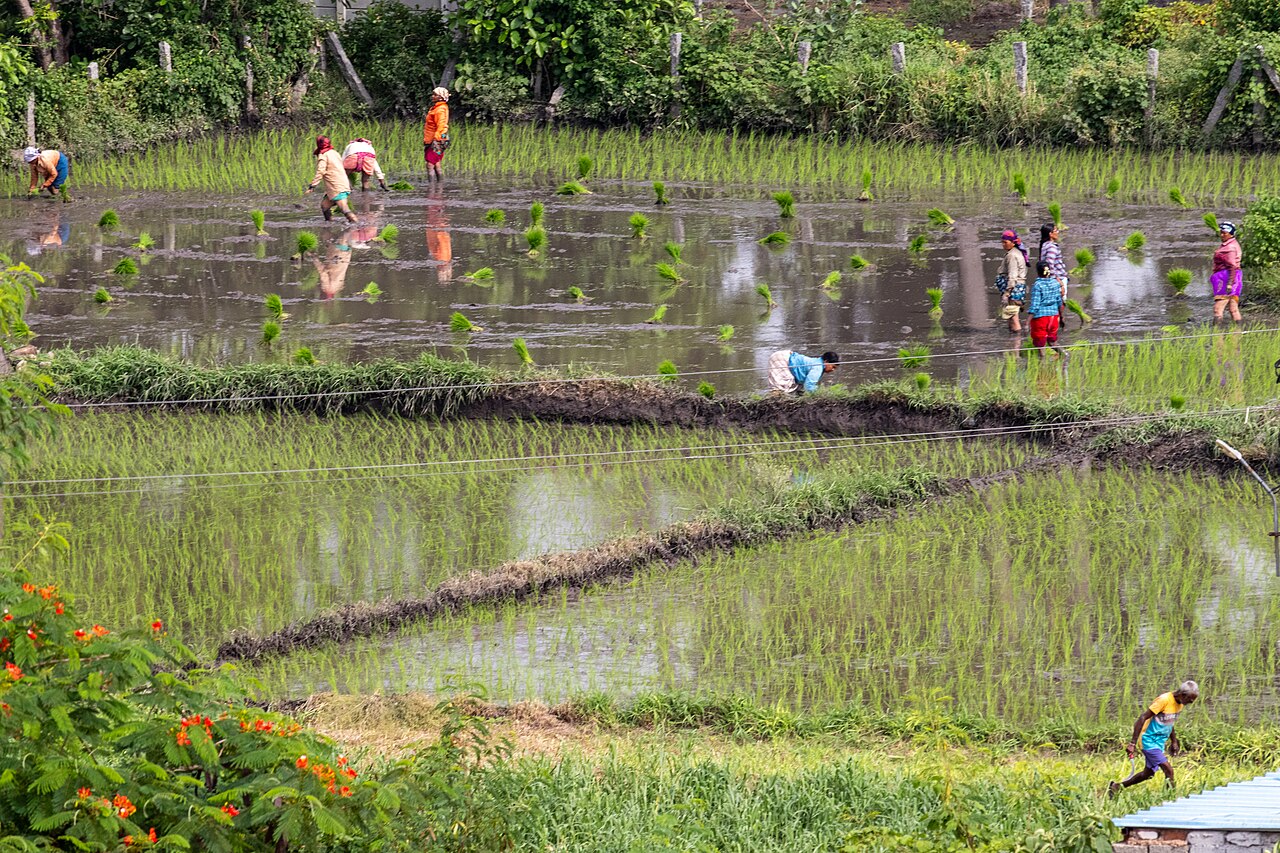
People working in the fields near Bhongir Fort | Ashok Vootla
Policy Issue
Farmers face a fundamental challenge: they must make key production decisions based on expectations about the weather, yet weather is difficult to predict. When farmers’ beliefs do not match realized conditions, they can end up making investment choices that are poorly suited to the growing season, which could generate meaningful welfare losses. For many farmers, one of the most consequential—and uncertain—weather events are the onset of the monsoon. The onset of the monsoon is highly variable, and monsoon timing has large effects on agricultural production: an earlier onset, and therefore longer growing season, can substantially raise yields.
Yet farmers’ beliefs about when the monsoon will arrive also vary widely, suggesting that many may be substantially off about its timing. This can have important consequences. If farmers expect an earlier monsoon, and thus a longer growing season, they may cultivate more land and plant higher-value crops. But if rains are delayed and the season is shorter than anticipated, those investments may be lost. Conversely, if farmers expect a late monsoon and therefore a shorter growing season, they may cultivate less land. If rains arrive early and the season is longer than anticipated, they may miss out on higher returns by not expanding cultivation.
A promising approach to help farmers align their beliefs with actual realizations is to provide farmers with accurate, long-range seasonal weather forecasts, which can help guide decisions about land use, crop choice, and off-farm work. Long-range forecasts are promising in principle, but there is limited evidence about whether they can impact farmer beliefs and investment decisions. Moreover, there are reasons to believe that forecasts may be less effective in low- and middle-income country settings: farmers may not believe information coming from a forecast, they may not know how to use the forecast to form beliefs, or they may not be able to update their investments if they face land, labor or credit constraints.
Context of the Evaluation
Agricultural production is central to many low- and middle-income economies. In Telangana, the setting for this evaluation, about 55 percent of workers are engaged in agriculture, primarily on small farms that depend heavily on summer monsoon rains. Yet the monsoon’s arrival is highly variable, with meaningful consequences for output. For example, using district-level yield data combined with daily gridded precipitation from this evaluation, researchers estimate that a monsoon arriving three weeks late reduces rice yields by roughly 2–3.4 percent and cotton yields by 5.2–8.6 percent.
Farmers’ beliefs about monsoon onset vary widely. Although the average prior belief is close to the realized onset date, individual predictions vary considerably, meaning many hold expectations that are far from what ultimately occurs. In particular, some farmers expect the monsoon to arrive up to four weeks earlier than others, which ultimately affects their investment decisions.
In this setting, farmers also have limited access to formal weather forecasts. Most rely on other farmers for weather information, and fewer than 10 percent report receiving information from the government or extension services. As a result, even when sophisticated forecasts exist, they often do not reach these farmers. In particular, the Potsdam Institute for Climate (PIK) produces a seasonal forecast for Telangana that leverages recent advances in weather modeling. This forecast predicts monsoon onset roughly 40 days in advance—early enough for farmers to adjust key decisions for the coming season, including how much land to cultivate, which crops and inputs to use, and whether to invest in non-farm activities. The forecast has been accurate in each of the past ten years, and back-testing over the past fifty years suggests it is correct about 73 percent of the time.
Details of the Intervention
Researchers conducted a randomized evaluation to test the impact of providing long-range seasonal weather forecasts to farmers. They randomly assigned 250 villages in Telangana to one of three groups:
- Forecast group (497 households in 100 villages): Households in these village received the weather forecast. The forecast read as follows: this year’s forecast says the monsoon is likely to start over Telangana between June 11th and June 19th. This is likely to be followed by a dry spell from June 20th to June 29th. The continuous monsoon rainfall is expected after June 29th.
- Insurance group (248 households in 50 villages): Households in these villages received an index-insurance product. The purpose of this intervention group was to (1) benchmark the effects of providing a forecast against a common agricultural policy tool – insurance –, and (2) examine how farmers’ prior beliefs shape their responses to insurance, as a means of revealing an additional channel through which forecasts—by aligning beliefs with realized conditions—may improve farmer response to insurance.
- Comparison group (495 households in 100 villages): Households in these villages were not offered either weather forecasts or insurance.
When the forecast was issued in early May, researchers first elicited each farmer’s prior beliefs about monsoon onset and administered a short survey. They also delivered the forecast to households assigned to the forecast group. The forecast was for an average year, and the forecast was extremely accurate in our study. A few weeks later, they returned to elicit posterior beliefs from all farmers. Finally, after the harvest, they collected data on investments, production, and household welfare.
Results and Policy Lessons
Farmers who received the weather forecast shift their beliefs, agricultural investments, and non-agricultural investments, ultimately improving their welfare.
Farmers’ beliefs about the monsoon: Farmers who received the forecast update their expectations toward the predicted monsoon onset date. Farmers who received the forecast held beliefs that are 27 percent closer to the forecasted date than those in comparison villages.
The impact of the forecast on these outcomes varies by farmers’ initial beliefs about monsoon onset timing. More specifically, the monsoon forecast in the study year predicted an average monsoon. All farmers in the forecast intervention group received the same predicted onset date. Yet, for farmers who had expected a late monsoon, this forecast implied an earlier arrival than anticipated; for those who had expected an early monsoon, it implied a later arrival. Finally, there was a group of farmers whose prior expectations already matched the forecasted onset date, for whom we would not expect any change in behavior. Results for these groups are summarized below:
Land use and crop choice: Farmers in villages that were offered forecasts updated their decision-making for the upcoming season in response to the forecast. Specifically, farmers who were told the monsoon would be later (worse) than they expected reduced land under cultivation by 22 percent and were 31 percent less likely to add a crop type from last year to this year. Farmers who were told the monsoon would arrive as they expected did not change their land under cultivation or their crop choices. Finally, farmers who were told the monsoon would be better than expected) increased land under cultivation by 21 percent, and were 36 percent more likely to grow a cash crop
Input investment: Farmers who were told the monsoon would be later (i.e., worse) than they expected (“early prior farmers”) reduced agricultural investment by 0.08 SD on an index composed of land cultivated, crop choice, and input use. Farmers who were told the monsoon would arrive as they expected (“middle prior farmers”) did not change their behavior; and farmers who were told the monsoon would be earlier (i.e., better) than expected (“late prior farmers”) increased agricultural investment by of 0.31 SD relative to the comparison group.
Agricultural output and profits: In principle, farmers who planted more should earn higher profits, while those who planted less should earn lower profits. However, severe flooding across the study area disrupted this relationship, so changes in inputs did not translate perfectly into expected profit outcomes. When flood-affected farmers were excluded from the analysis, profits aligned more closely with the input patterns. Although the estimates are imprecise, farmers who were told the monsoon would be later (i.e., worse) than they expected experienced a 22 percent decline in agricultural output and a US$341 reduction in profits. There is no change for farmers who were told the monsoon would arrive as they expected. There is suggestive evidence that farmers who were told the monsoon would be earlier (i.e., better) than expected increased production by 57 percent, with agricultural profits rising by about US$493.
Off-farm businesses: There is suggestive evidence that farmers who were told that the growing season would be later (i.e., worse) than they expected, increased non-farm business operation by 42 percent, while farmers, who were told that the growing season would be earlier (i.e., better) than they expected, decreased business operation by 35 percent.
Effects on well-being: Farmers’ welfare improves by 0.06 SD – driven by an increase per-capita food consumption by 7 percent relative to the comparison group of US$13.22 over the prior 30 days, and suggestive evidence of increased (asset value and net savings. By way of comparison, these welfare effects are four times larger than those found for emergency loans [1] and slightly more than half as large as the impacts of a large-scale irrigation scheme [2] suggesting that forecasts can generate comparable welfare gains to other programs at a fraction of the cost.
Taken together these results suggest that weather forecasts can bring farmer beliefs closer to actual weather realizations, and this can drive changes in investment behavior on and off the farm. This in turn translates to meaningful improvements in welfare. Over the past year, the study’s findings have helped inform government decisions to expand the dissemination of these forecasts.
[1] Lane, Gregory (2024): “Adapting to floods with guaranteed credit: Evidence from Bangladesh,” Econometrica.
[2] Jones, Maria, Florence Kondylis, John Loeser, and Jeremy Magruder (2022): “Factor market failures and the adoption of irrigation in Rwanda,” American Economic Review, 112 (7), 2316–2352.